
Call Now · (623) 306-5091
Serving Chandler, Gilbert, Mesa & Tempe  |  ★ 5.0 on Google  |  (623) 306-5091
Home › Blog › When to Acid Wash a Pool
Pool Surface Care & Restoration

When Does Your Pool Need an Acid Wash? (And When It Ruins Plaster)

Balanced Poolz specialist evaluating Arizona pool plaster for calcium scaling and mineral staining
A drained East Valley residential pool undergoing professional plaster surface diagnostics before applying a controlled mineral removal treatment.
Quick Answer

An acid wash is necessary in Arizona when mineral scale, black algae roots, or copper staining penetrate deeper than manual brushing can remove, typically every 5 to 7 years when Total Dissolved Solids (TDS) exceed 2,500 ppm and calcium hardness climbs past 800 ppm. Because a controlled acid wash chemically strips approximately 1/32 to 1/16 inch of surface cement to reveal clean plaster beneath, it should never be performed on brittle plaster thinner than 3/8 inch or surfaces exhibiting hollow structural delamination.

Comparing Plaster Treatments in Arizona's Arid Climate

This technical comparison is drawn from field diagnostics performed across hundreds of East Valley swimming pools and specifications outlined by the National Plasterers Council (NPC) — not generic online pool tips.

Factor Light Chemical Wash Full Acid Wash (1:1) What We Observe in Arizona
Surface Etching & Cement Removed Cleans surface film only (< 1/64"); uses buffered sulfamic acid. Chemically etches 1/32" to 1/16" of cement paste to expose fresh white cement. East Valley tap water leaves dense calcite crystal shells. A controlled 1:1 muriatic blend is necessary to dissolve mineral crusts without gouging marble aggregate.
Algae & Deep Mineral Eradication Cleans light surface dust, organic leaves, and mild mustard algae. Dissolves stubborn copper stains, fertilizer burns, and black algae roots. Summer pool water temperatures exceeding 90°F drive black algae micro-filaments deep into plaster pores where standard chlorine levels cannot reach.
Lifespan & Frequency Limits Safe every 1 to 2 seasons for cosmetic refreshing. Maximum 2 to 3 times over a plaster shell's 10 to 15-year lifespan. Over-acid washing eats away smooth cement paste, leaving a sandpaper-like finish that snags automatic pool sweeps and accelerates rapid scale re-accumulation.
Drainage & Thermal Requirements Often performed submersed or with a shallow partial water drop. Requires 100% pool drainage followed by continuous soda ash neutralization. Must be executed when ambient temperatures remain below 85°F. Draining plaster under direct 105°F+ summer sun triggers catastrophic plaster hydration shock and cracking.

How Hard Water and Desert Dust Transform Pool Plaster

In communities like Gilbert, Mesa, and Chandler, municipal tap water enters your pool with Total Dissolved Solids (TDS) already exceeding 700 to 800 ppm. Over a typical Arizona summer, high evaporation leaves pure water behind as vapor while minerals concentrate. Within 3 to 5 years, water hardness often spikes beyond 2,500 ppm TDS and calcium hardness tops 900 ppm.

When the Langelier Saturation Index (LSI) shifts into scale-forming territory, calcium carbonate precipitates out of solution, bonding to underwater walls as a rough, gray-white sandpaper crust. Brushing with a standard nylon or stainless steel pool brush simply slides over this hardened mineral stone without making a dent.

The 3 Unmistakable Signs Your Pool Requires an Acid Wash

  • Black Algae Colonization: If you see pinpoint black spots with protective waxy caps that survive repeat chlorine shock treatments, the roots have anchored into the plaster substrate. An acid wash dissolves the anchoring matrix.
  • Widespread Calcium Carbonate Encrustation: When underwater plaster transitions from smooth marble to a rough surface that snags swimsuits and scratches swimmers' feet, the surface requires mineral etching.
  • Severe Mineral Staining: Irrigation overspray containing dissolved iron, copper from older corroding heater cores, or heavy manganese deposits leave dark red, brown, or teal blotches that only targeted acid application can lift.
Field Observations: What We Encounter on East Valley Pool Pads

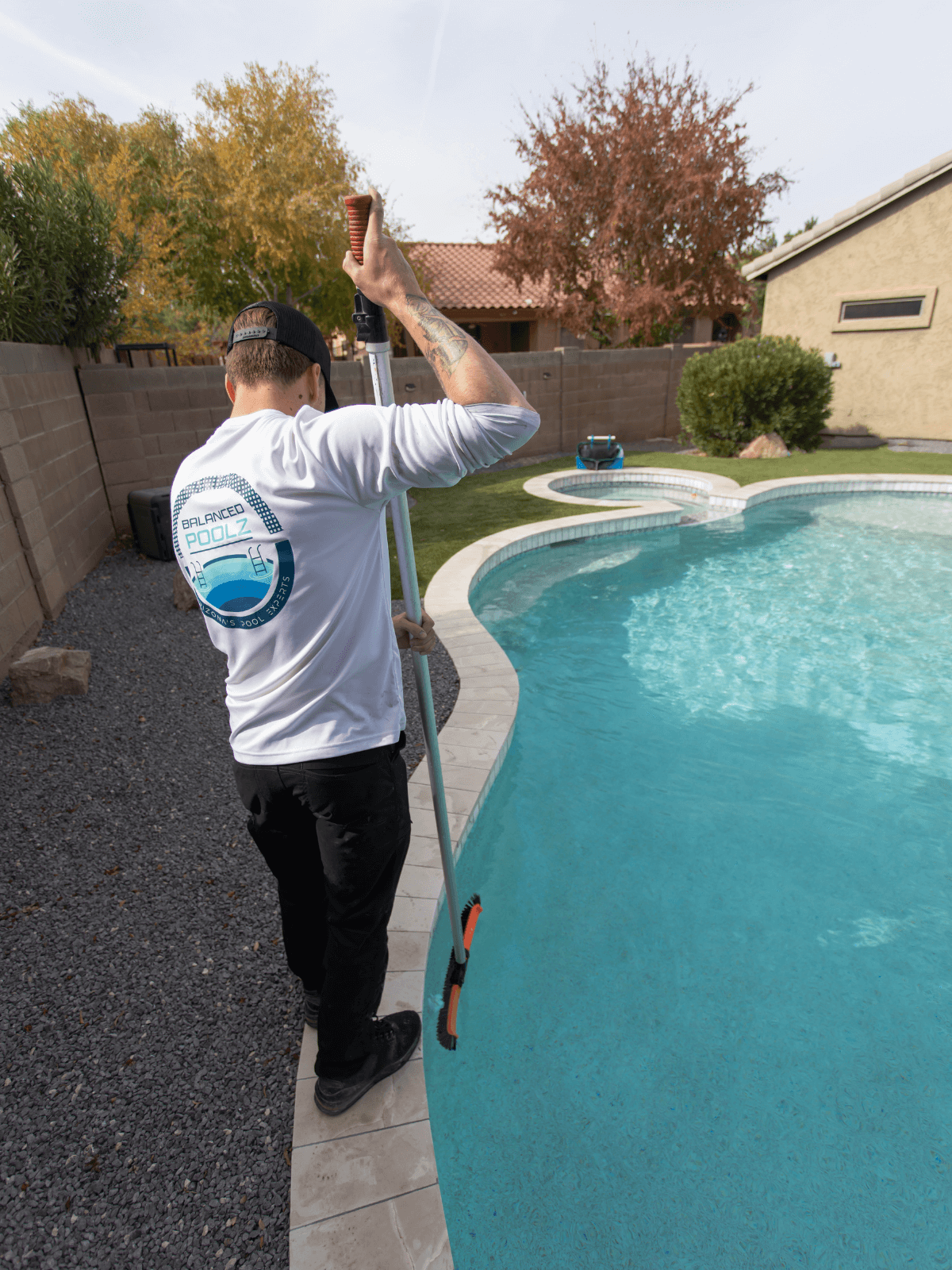
When homeowners call us regarding stubborn stains or coarse plaster, the first step is an on-site physical check before ever considering draining water. We test calcium saturation, tap the plaster with a rubber mallet to check for hollow delamination, and measure the remaining plaster thickness around the main drain. If the plaster layer is healthy, a controlled 1:1 muriatic wash removes mineral crusts without damaging structural aggregate.

Balanced Poolz technician executing a controlled pool acid wash in Mesa AZ
Field Restoration · Citrus Shadows, Mesa AZ Evaluating a 6-year-old plaster pool where Total Dissolved Solids reached 2,850 ppm and calcium hardness climbed to 920 ppm. Controlled 1:1 acid treatment restored smooth, bright plaster within 4 hours without aggregate erosion.

Real Project: Citrus Shadows, Mesa Surface Rehabilitation

A homeowner in Citrus Shadows noticed heavy teal staining across pool steps and gray mineral scale along the deep end floor after an older copper heater core had leaked into water with an LSI imbalance. Our crew drained the pool early on a 74°F October morning, pre-wet the shell, applied section-by-section acid in 6-foot vertical drops, and immediately neutralized the collection basin using a saturated sodium carbonate (soda ash) bath. By 4:00 PM, the pool was refilling with clear tap water and pristine, unstained plaster.

Explore our East Valley pool repair services

What Plaster Engineering Standards & Environmental Rules Mandate

Unlike consumer DIY forums that advocate pouring straight muriatic acid down pool walls, commercial pool restoration is governed by strict engineering thresholds established by the National Plasterers Council (NPC) and state environmental regulations:

3/8" Depth
NPC Plaster Thickness Threshold
1:1 Maximum
Controlled Water/Acid Dilution
pH 6.5 – 9.0
ADEQ Discharge Requirement

According to the NPC Technical Manual, pool plaster is a cementitious composite of white Portland cement and crushed marble aggregate. Overly aggressive acid etching removes the smooth cement paste binder, exposing the softer aggregate beneath. Furthermore, the Arizona Department of Environmental Quality (ADEQ) strictly prohibits draining acidic or chlorinated pool water directly into municipal storm drains; wastewater must be dechlorinated and neutralized with sodium carbonate (soda ash) before controlled sanitary sewer discharge.

When an Acid Wash Is the Wrong Choice (And Harms Your Pool)

Honest Specialist Counsel

We regularly advise Arizona homeowners against performing an acid wash when underlying plaster integrity is compromised. If your plaster is worn thinner than 3/8 inch or the dark gray gunite substrate is shadowing through the surface, acid etching will burn through the remaining cement matrix and accelerate structural leaks. In this condition, complete replastering or resurfacing is the only durable solution.

Likewise, if tapping the pool surface produces hollow, drum-like sounds (indicating subsurface delamination), or if pebble finishes exhibit loose stones collecting in the pump basket, acid exposure will dissolve the remaining binder and cause large plaster plates to pop loose. Telling homeowners when an acid wash will cause more harm than good is a core principle of how we operate.

Frequently Asked Questions About Acid Washing

Most standard white marcite plaster pools should only be acid washed 2 to 3 times across their entire 10 to 15-year functional lifespan. Because each treatment dissolves approximately 1/32 to 1/16 inch of cement binder, over-washing degrades the plaster into an abrasive, porous texture that accelerates future mineral adhesion.

Pool draining and acid washing should never be performed when daytime ambient temperatures exceed 85°F to 90°F. Draining a pool in direct Arizona summer heat creates severe hydration shock, causing wet plaster to shrink, crack, or bubble away from the gunite shell within hours.

An acid wash cleans underwater plaster surfaces. While light calcium film on tiles can sometimes be softened, heavy crystalline calcium rings along waterline tile typically require specialized low-pressure glass bead blasting or mineral soda blasting to avoid chipping tile glaze.

An acid wash is a restorative surface cleaning procedure that strips superficial stains and mineral crust from existing plaster. Replastering is a complete construction overhaul that chips out failed plaster down to the gunite shell and applies a completely fresh 3/8" to 1/2" layer of brand-new plaster or pebble aggregate.

Need an honest assessment of your pool plaster?

Text or call us with two photos of your pool plaster or waterline tile — we will evaluate your surface condition and tell you honestly whether an acid wash or water exchange is best.

Request Assessment (623) 306-5091

Keep Reading

Acid Washing Services (Service Hub) Weekly Maintenance (Service Hub) Green to Clean Recovery (Service) Mesa Pool Repair (Location Hub) Chandler Pool Repair (Location Hub) All Valley Service Areas